
A researcher at the University of Portsmouth claims that information not only plays a structural role in the universe, but also has a form of physical mass. The universe may be even more surprising than previously believed. A team of researchers led by Melvin Vopson, a physicist specialising in information theory at the University of Portsmouth, claims that information is not completely abstract, but has mass, which would allow it to be considered a new state of matter. If confirmed, this argument would challenge the traditional classification of physical states — solid, liquid, gas and plasma — and usher in a paradigm shift in modern physics.
Information could be the fifth state of matter
Traditionally, four states of matter are recognised: solid, liquid, gas and plasma. However, physicist Melvin Vopson proposes that information could also be considered a fifth state of matter, albeit with extremely small mass. According to his hypothesis, each bit of information has a minimal but measurable mass. To test this idea, he suggests an experiment in which positrons and electrons collide, releasing an extra amount of energy when the information they contain disappears. If this effect were proven, it would confirm that information is a physical component of the universe and could even provide clues to understanding unsolved mysteries, such as dark matter.
Information has mass: the discovery that could change data storage

This discovery has profound practical implications for future technological development. If each bit of information has a finite mass — however small — then digital storage is also subject to concrete physical limits, not just technical or economic constraints.
Today, humanity generates unprecedented volumes of data: billions of emails, social media posts, video streams, digital files and messages are produced daily across the globe. This exponential growth in information has an increasingly high energy cost, sustained by data centres that operate around the clock and require enormous amounts of electricity.
According to the author himself, if this trend continues, the production and maintenance of digital information could exceed the planet’s available energy capacity in just over a century. In this context, understanding the physical mass of information not only acquires conceptual relevance, but also becomes a key factor in the design of new, more efficient, compact and sustainable storage technologies. An experiment with electrons and positrons seeks to prove that data is not abstract: it also has mass.
The universe as organised information: gravity, simulation and the role of technology
If information has mass, then it ceases to be a purely abstract concept and becomes a physical component of the universe. In this theoretical framework, gravity would not only be a force that attracts bodies, but also a mechanism that organises information, transforming chaos into orderly structures, from subatomic particles to galaxies. This idea is directly linked to the hypothesis that the universe could function as a computer simulation, where reality is processed through precise mathematical rules and constant flows of information.
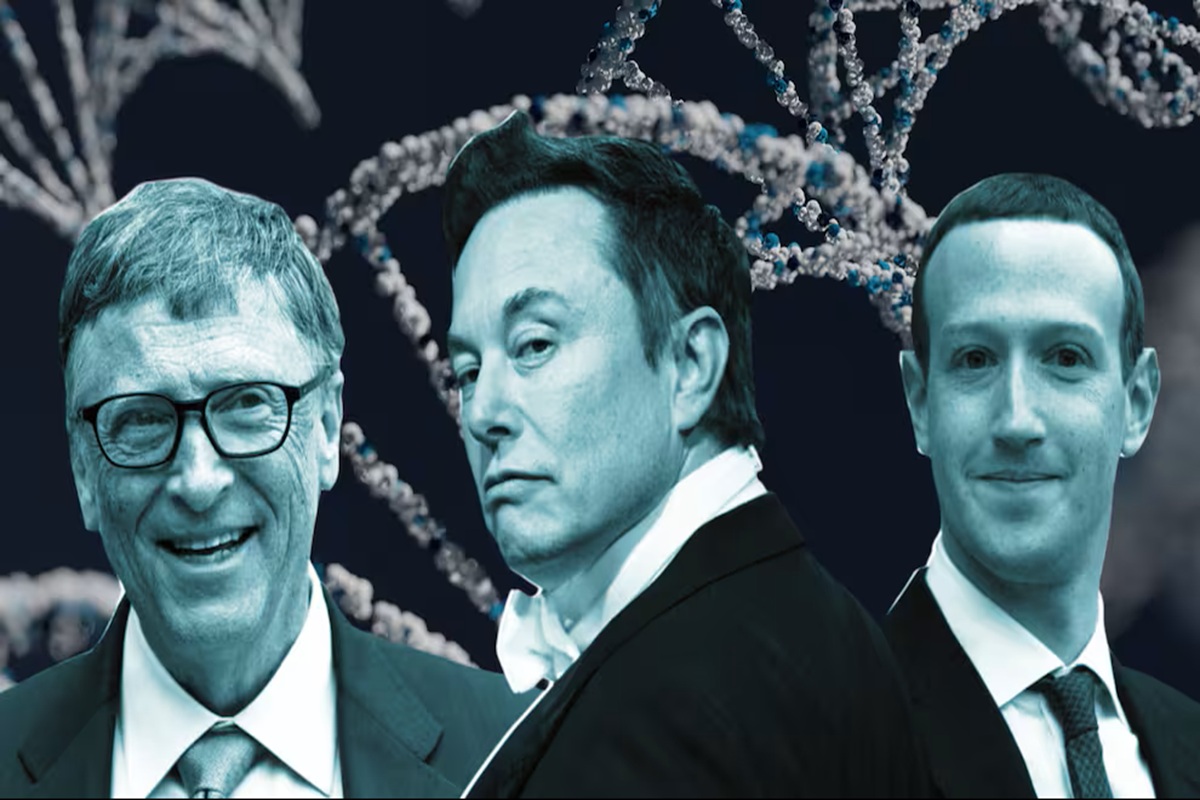
From a technological point of view, this vision takes on an even deeper dimension. Figures such as Elon Musk, Bill Gates, and Mark Zuckerberg, leaders of projects related to artificial intelligence, massive computing, and virtual environments, could be interpreted as central actors — or ‘guardians’ — of the infrastructure that produces, stores, and organises enormous volumes of information. Their power lies not only in innovation, but in their control of the systems where the information that moves the world is concentrated, processed, and monetised: servers, data centres, algorithms, global platforms, and artificial intelligence networks.