
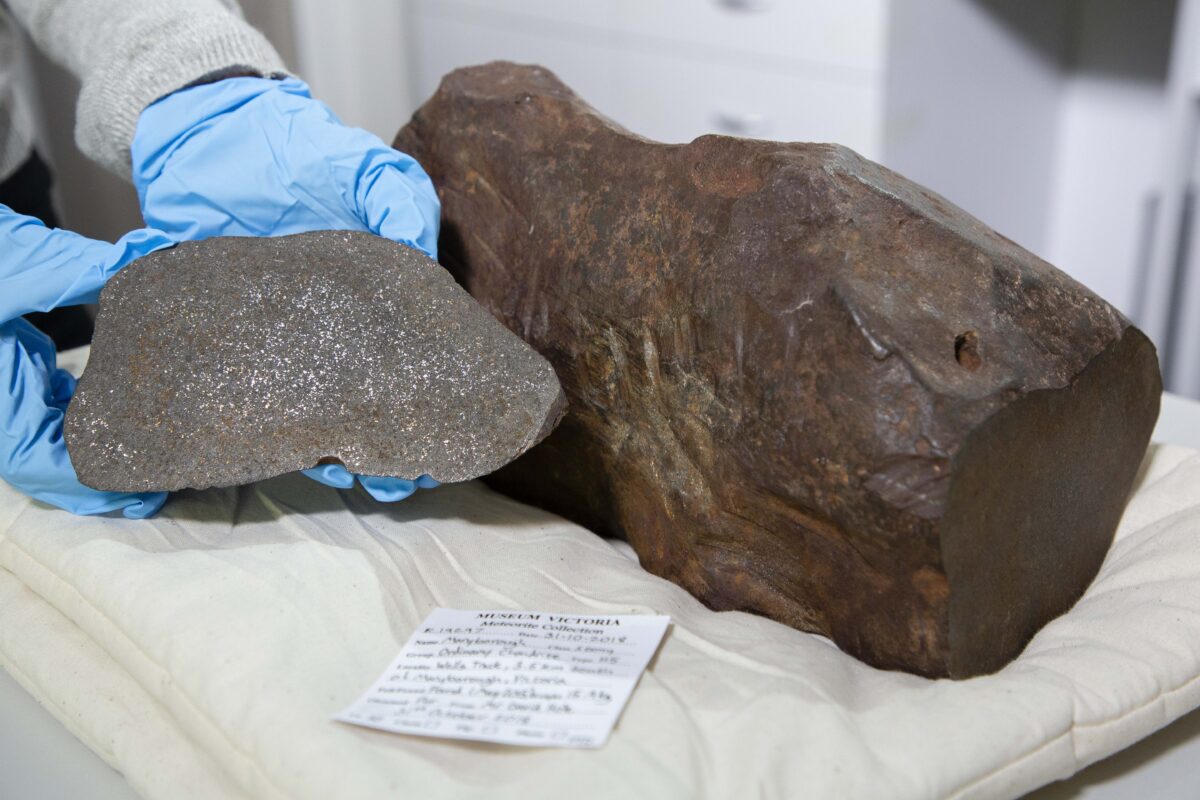
Long unknown, this rock contained a dense metallic composition and microscopic crystals formed in the early stages of the solar system’s development. Its scientific analysis transformed a common find into a source of important information for planetary geology.
Some treasures remain invisible to those who seek them. While prospectors roam the red earth in search of precious metals, sometimes there is another treasure beneath their feet. Much older than gold and infinitely rarer, a fragment of the solar system unexpectedly emerged from beneath the earth in the state of Victoria. The Maryborough meteorite, discovered by a man convinced he had found a gold nugget, completely changed the perception of what still lies hidden in familiar landscapes.
A rock too dense to be ordinary
In 2015, David Howell searches the dusty soil of Maryborough Regional Park in the state of Victoria with a metal detector. He was convinced that he had found a large nugget stuck in a reddish stone, heavy as lead. The man still did not suspect that what he had in his hands was billions of years old.
When he returned home, he tried the impossible to break the stone. Saw, sander, drill, acid… nothing worked. Even hammer blows ricocheted off its surface. Disappointed but intrigued, he kept this piece for many years, until curiosity got the better of him. Finally, he took it to the Melbourne Museum. There, two geologists, Dermot Henry and Bill Birch, quickly realised that this was no ordinary terrestrial mineral.

Of the thousands of stones that dreamers in search of meteorites brought to the museum, only two were authentic. The Maryborough stone is one of them, and it is far from ordinary. The object has no visible fusion crust, but its unusual mass and sculptural texture put the experts on the right track.
The Maryborough meteorite reveals its 4.6 billion years
Experts cut a thin layer from the block with a diamond saw. Inside, they discover a uniformly crystallised matrix, permeated by tiny metallic droplets called chondrules. This is a clear sign of material born in the primitive solar nebula, even before the formation of the Earth.
According to the study, the meteorite is almost 39 cm long, weighs 17 kg and belongs to the class of ordinary chondrites, more specifically to the H5 type. This type of rock, rich in iron and nickel, is characterised by marked recrystallisation of the matrix and small changes resulting from impacts.
The percentage of preserved metals, the presence of minerals such as kamacite, taenite, and even traces of natural copper confirm the age of the sample and the absence of damage since its fall to Earth. Carbon-14 dating, carried out at the University of Arizona, indicates a fall that occurred less than 1,000 years ago. However, no crater was found.
It has not been possible to officially link any eyewitnesses to the impact. Only a few newspaper archives between 1889 and 1951 mention luminous bolides in this region, but they are not accurate enough to establish a connection. If the meteorite escaped the prospectors for a century, it may be thanks to its perfect camouflage in the yellow clay of the eucalyptus forest.

A celestial fragment rarer than gold
The Maryborough meteorite is the seventeenth recorded in the state of Victoria. However, in the same region, where gold fever raged in the 19th century, thousands of gold nuggets have been found. For scientists, this rarity makes it a valuable piece, without commercial value.
Some meteorites contain primary organic molecules, including amino acids. Others preserve stardust older than the Sun itself. These objects allow us to trace the origin of the elements in the periodic table and sometimes even understand how the building blocks of life could have travelled through the cosmos.
In the case of Maryboro, geochemical data indicate that it came from the asteroid belt between Mars and Jupiter. The collision of two celestial bodies likely pushed the meteorite towards Earth. It then passed through the atmosphere before landing intact on Australian soil.
It is difficult to imagine that a single touch of the detector was enough to bring to the surface a relic formed long before the emergence of our planet. However, this is how science usually advances. By chance, thanks to patience and curiosity, which ultimately reveal the secrets of the sky.