
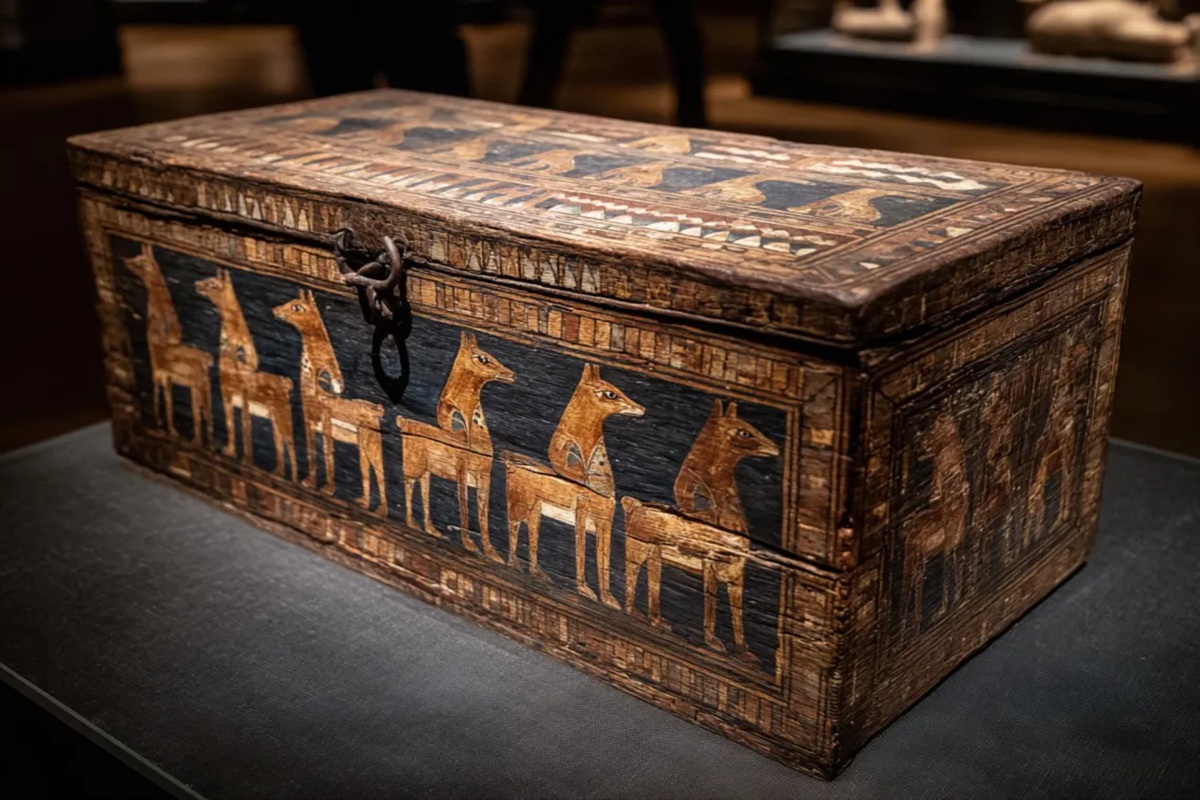
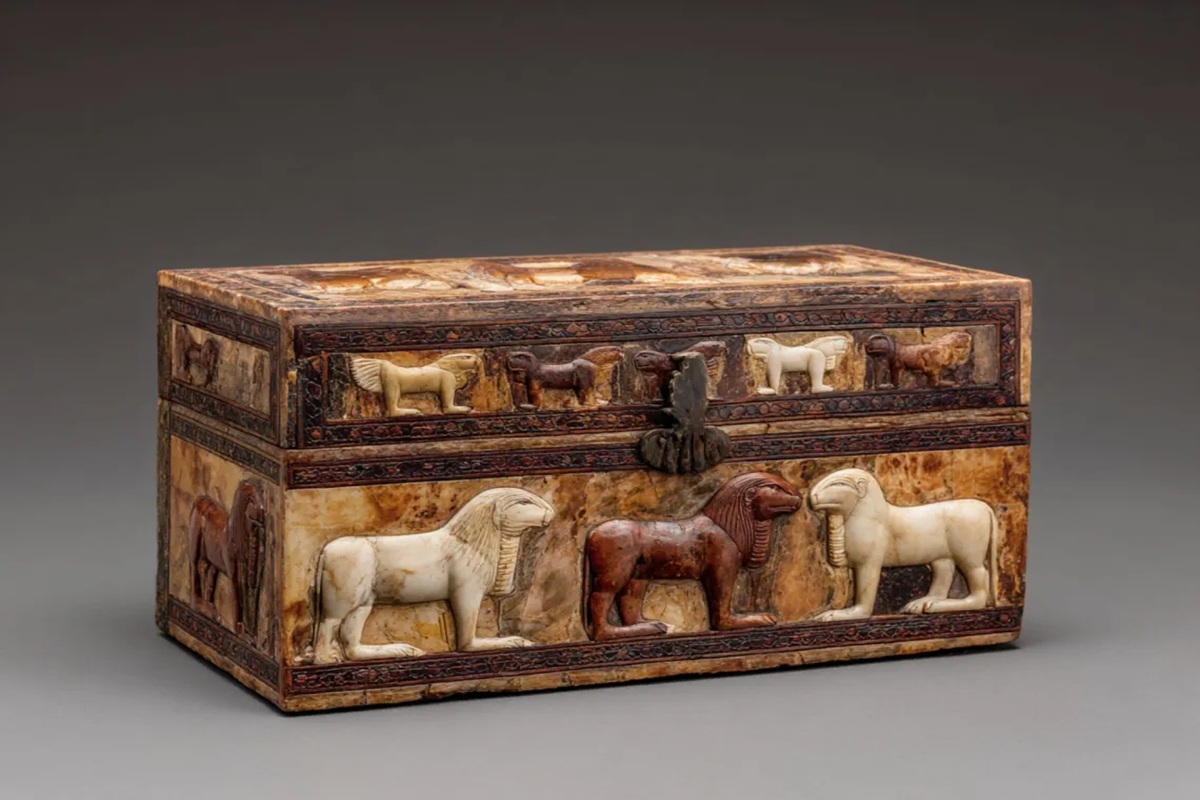
Found in the pre-Roman necropolis of the same name, the Belmonte Piceno box is a unique archaeological find that attests to the richness of the ancient Picene culture. The Italic necropolis of Belmonte Piceno is one of the most significant enclaves of ancient Picene culture. During the 2018 excavations, archaeologists discovered an object that completely changed the interpretation of the archaeological monument: a small ivory and amber chest of exceptional artistic quality. Thanks to modern research methods, it was possible to extract the entire object, restore it and make it accessible to both the scientific community and the general public. Thus, we can once again admire an object that remained hidden for over 2600 years.
Sphinxes and heroes in amber and ivory: an unprecedented masterpiece
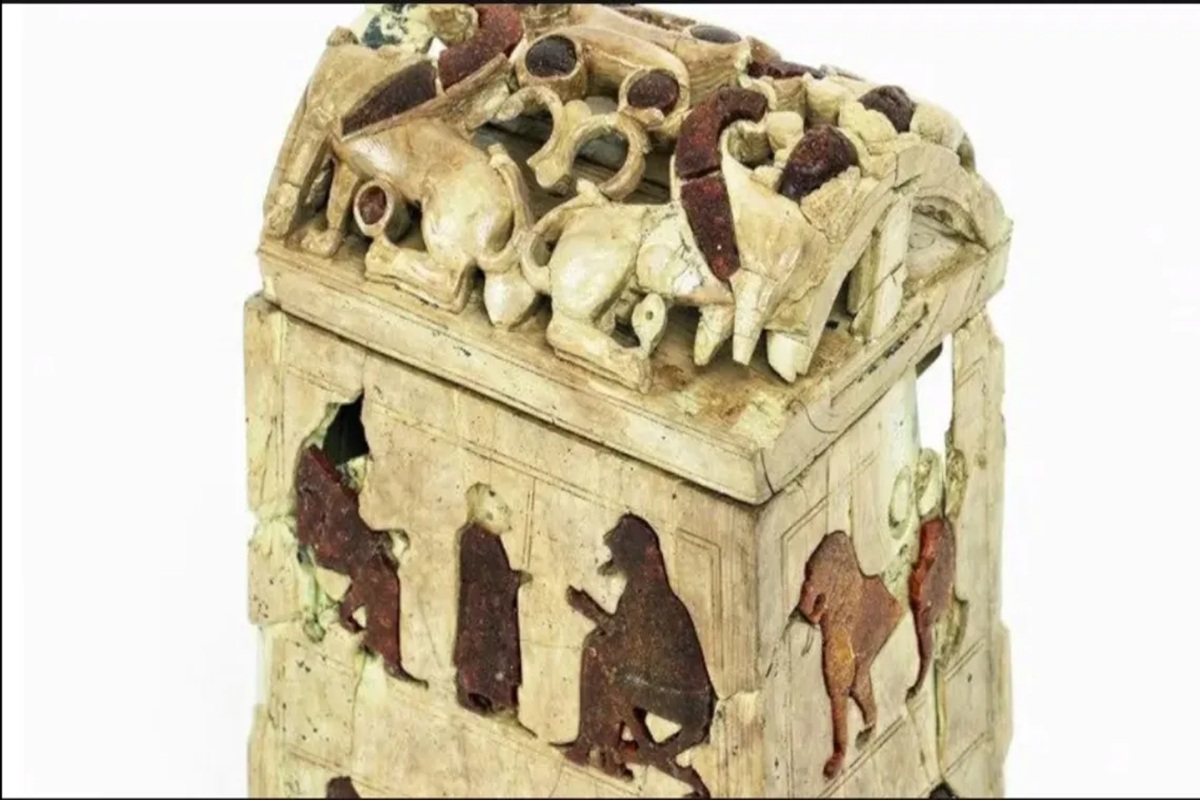
The chest stands out both for the rarity of its materials and its unusual manufacturing technique. It is composed of finely crafted ivory plates and carved amber elements. The lid features four sphinxes with elegantly carved wings, whose faces and some details are made of amber to enhance their expressiveness thanks to the transparency of the material. Eighteen figures are placed on the body of the chest, executed with surprising meticulousness. These small scenes, organised into metropolises, represent figurative motifs with great narrative dynamics. The upper part depicts characters of high social standing or, perhaps, deities linked to aristocratic ceremonies or prestigious rituals. In the lower part, the ensemble transforms into a true heroic cycle: the confrontation between Perseus and Medusa, the transport of Achilles by Ajax, Cassandra depicted alongside Priam and the statue of Athena, as well as other scenes inspired by tragic episodes from Greek epic poetry. The iconography suggests a profound symbolic interpretation of the chest. According to researchers, all the images recall the fragility of both heroes and mortals in the face of death, and this message takes on even greater significance when we consider that the object comes from a funerary context.
Chest reveals long-distance cultural links
The presence of this object in the Piceno territory, a region corresponding to the current regions of La Marca and northern Abruzzo, attests to the existence of much richer and more intense contacts and exchange networks than previously assumed. Ivory and amber, prestigious and therefore difficult to obtain materials, indicate the existence of local elites who were able to acquire luxury items from Mediterranean circles. At the same time, according to experts, the heroic iconography of the chest indicates that the Picenes adopted, reinterpreted and attributed new meaning to myths of Greek origin within their own cultural system. On the other hand, this discovery led archaeologists to revise the history of the tomb itself in which the chest was found. Although the tomb had been known since the early 20th century, only recent excavations have revealed elements that had previously been unexplored.
The restoration that brought a forgotten treasure back to life
To restore the chest, archaeologists had to resort to an extremely delicate technical process. Amber, a fragile material that is very sensitive to changes in humidity and temperature, was in a vulnerable state. The intervention made it possible to reinforce its surface, remove old deposits and restore the characteristic transparency of the inlaid figures. The ivory, on the other hand, required a completely different approach to avoid tension and deformation. The combination of two materials with different properties in a single object required an interdisciplinary approach. Despite the difficulties, the intervention was a success and, for the first time since its discovery, it is possible to appreciate the original complexity of the chest, created by a master craftsman in the 6th century BC. In addition, the restoration not only restored the aesthetic appearance of the object, but also revealed previously invisible iconographic details, such as the presence of small cuts on the back of the figures and the techniques used to attach the amber to the ivory.
First public exhibition: a cultural event
The public display of the chest in the museum space is an important milestone for the region’s archaeological heritage. The exhibition, organised on the occasion of European Heritage Days, allows this piece to be seen outside the laboratory for the first time in history. Its presence in one of the rooms of the National Archaeological Museum of Marche and Ancona offers researchers, students and visitors the opportunity to see a masterpiece of ancient craftsmanship up close. The temporary exhibition will be open to the public until 6 January 2026 and is part of a broad institutional initiative aimed at promoting archaeological culture.
An object that reappeared after more than two millennia
The Belmonte Piceno chest has become a key element in understanding the social and cultural development of the region in the 6th century BC. Its iconography reveals deep symbolic connections between the local world and the Mediterranean imagination, while the materials with which it was made indicate commercial exchanges and prestigious networks that spanned great distances. On the other hand, its technical quality attests to the existence of artisans (or contacts with foreign workshops) capable of working with extraordinary skill. Overall, this product changes the traditional view of the role of the Picentes in intercultural contacts in the ancient Mediterranean and places them as active participants in the exchange of ideas, objects, and symbols. Today, thanks to the recovery, restoration and popularisation of the Belmonte Piceno chest, we can better understand how a small community in ancient Adria entered into dialogue with the great narratives of the Mediterranean and created objects that combined technique, myth and prestige.